
The Danger You Do Not See
You made ₦80,000 in sales today. On the way home, you stop to buy food for the house — ₦5,000. Your child needs school supplies — ₦3,000. Your friend calls, you need to send ₦2,000. By the time you reach home, ₦10,000 has left the business without you even thinking about it.
This happens every day in shops across Nigeria. The money from the shop and the money for your personal life are all mixed together. You use the same account, the same wallet, the same pile of cash.
And then at the end of the month, you look at the business and wonder: “Where did all the money go?”
This is one of the biggest reasons small businesses in Nigeria fail. Not because they do not have customers. Not because their products are bad. But because the owner cannot tell the difference between business money and personal money.
Why Mixing Money Is Dangerous
Let us be clear about what happens when you mix business and personal money. It is not just “bad practice.” It actually destroys your business in specific ways.
1. You Cannot Tell If Your Business Is Profitable
When business money and personal money live in the same place, you cannot calculate your profit and loss accurately. You think your business expenses are ₦200,000 but ₦50,000 of that was actually personal spending. Or the other way around — you think you are doing fine, but the business is actually losing money and your personal savings are covering the gap.
Without knowing your true profit, you are flying blind. You cannot make good decisions about pricing, stocking, or expanding.
2. Your Business Slowly Bleeds Money
Every time you take money from the business for personal use without recording it, the business gets weaker. ₦2,000 here, ₦5,000 there. It feels small each time. But add it up over a month:
| What You Took | How Often | Monthly Total |
|---|---|---|
| Food / lunch | Daily ₦1,500 | ₦45,000 |
| Transport home | Daily ₦500 | ₦15,000 |
| Children school needs | Weekly ₦3,000 | ₦12,000 |
| Personal items | Weekly ₦2,000 | ₦8,000 |
| Unexpected (family, friends) | Weekly ₦3,000 | ₦12,000 |
| Total | ₦92,000 |
That is ₦92,000 per month taken from the business without being recorded. Over a year, that is over ₦1,000,000. Money that could have gone to buying more stock, improving your shop, or growing your business.
3. You Cannot Get a Loan When You Need One
Banks and microfinance institutions want to see your business finances before giving you a loan. If your business account has personal expenses mixed in — school fees, food shopping, airtime top-ups — they cannot see your real business performance. Your application gets rejected.
Even SMEDAN programs and government grants look at your financial records. Clean records show a serious business owner. Messy records show someone who is not ready.
4. Tax Problems
The Federal Inland Revenue Service (FIRS) and state tax authorities are getting more sophisticated. If you ever get audited, mixed accounts make it impossible to show what is business and what is personal. You could end up paying tax on personal money that passed through your business account, or face penalties for not keeping proper records.
5. You Eat Your Seed Corn
There is a saying in business: your stock is your seed corn. When you take money from the business for personal use, you are reducing the money available to buy stock. Less stock means fewer things to sell. Fewer things to sell means less revenue. Less revenue means even less money. It is a downward spiral.
Many provision store owners start the year strong and end the year barely surviving. Not because business was bad, but because they slowly ate through their stock money.
How to Separate: Practical Steps
You do not need to be perfect from day one. But you need to start.
Step 1: Open a Separate Business Account
This is the most important step. Open a new account specifically for your business. Good options include Moniepoint Business (free), Opay Business (low fees), Kuda (zero charges), or a traditional bank current account (needs CAC but gives access to overdraft).
All your business sales should go into this account. Your POS terminal should be linked to this account.
Step 2: Pay Yourself a Fixed Salary
This is the part most people get wrong. You think, “It is my business, I will take what I need.” That thinking kills businesses.
Instead, decide on a fixed amount you will take from the business every week or month as your salary. This amount should be based on what the business can afford, not what you want.
Here is a simple way to figure it out:
- Look at your average monthly profit (use our P&L guide if you have not calculated this).
- Set your salary at 30-40% of that profit.
- The remaining 60-70% stays in the business for stock, growth, and emergencies.
Example: If your business makes ₦80,000 profit per month, pay yourself ₦25,000 to ₦32,000. The rest stays in the business.
Transfer your salary to your personal account on a set day (like the 1st or 15th of each month). After that, do not touch the business account for personal things.
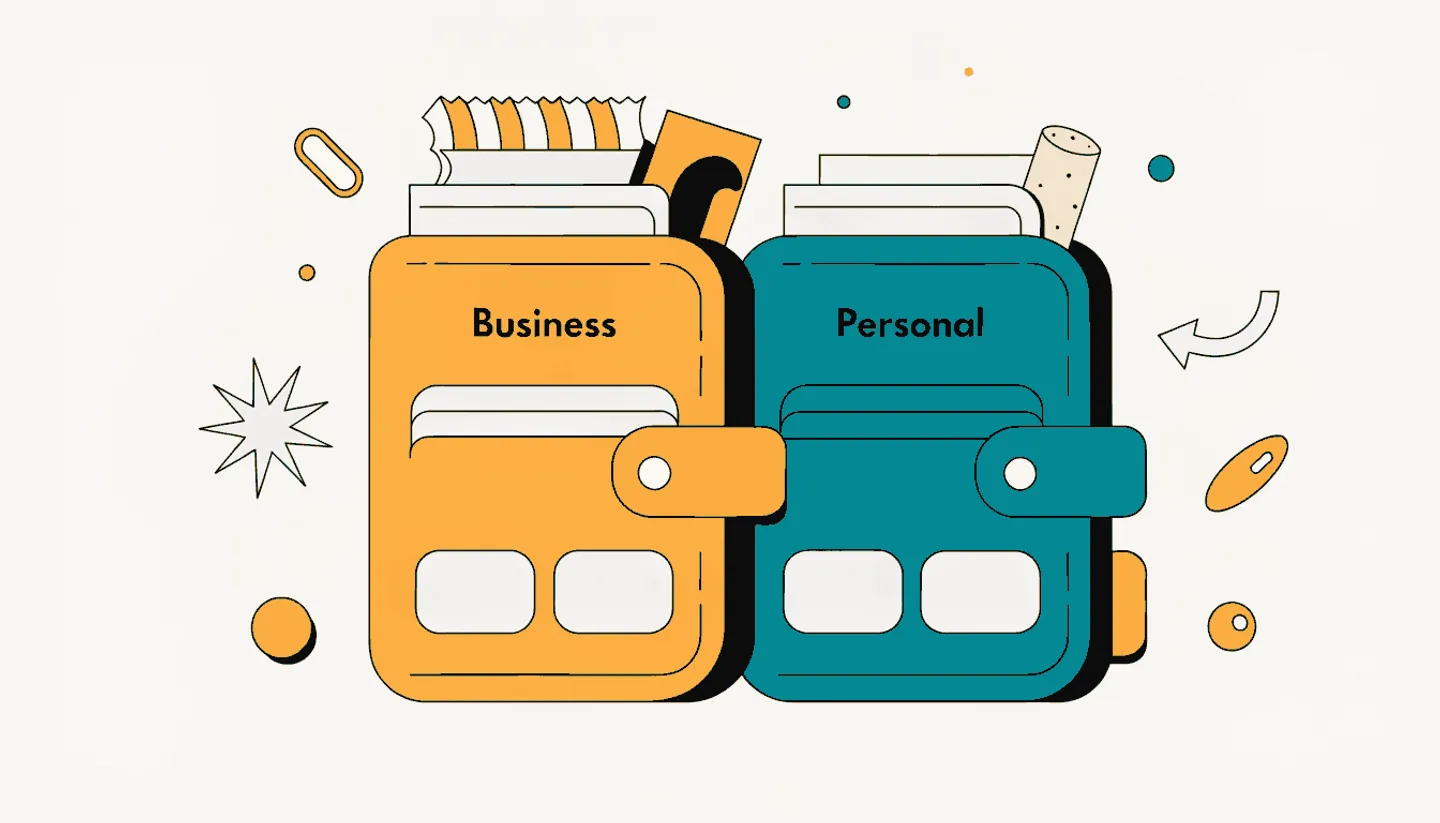
Step 3: Use Different Wallets or Envelopes for Cash
If your business runs mostly on cash, physical separation is important. Get two different containers, wallets, or envelopes:
- Business cash — this stays at the shop. Used only for business expenses like buying stock, paying staff, or paying suppliers.
- Personal cash — this is your salary. Take it home. Use it for food, family, transport, and personal needs.
Some people even use different colored bags or wallets to tell them apart. Whatever works for you. The point is that they should never mix.
Step 4: Record Every Withdrawal
Every time you take money from the business, write it down. Every single time. Even if it is ₦500 for a drink. There are three types of withdrawals:
- Business expense — buying stock, paying rent, buying fuel. These stay on the business record.
- Owner salary — your planned monthly pay. Record it as “Owner Salary.”
- Owner withdrawal — any extra money you take beyond salary. Record it as “Owner Withdrawal.”
The goal is to minimize category 3. If you find yourself making owner withdrawals often, your salary might be too low, or your personal spending needs adjustment.
Step 5: Handle Business Expenses Properly
Pay all business expenses from the business account or business cash. Do not use your personal money to “help” the business and then try to track it.
If the business cannot afford an expense, make a formal “owner loan” — put your personal money into the business account and record it as a loan. The business pays it back later.
What About When the Business Is New?
When your business is starting, you might be funding it from personal savings. That is normal. But write down every Naira you put into the business as “Owner Investment.” This is money the business owes you. When profit starts coming, it pays you back.
From day one, have a separate account or cash envelope. Even if the business operates from your parlour. Separation is a habit. Start early.
Common Excuses (And Why They Do Not Work)
“My business is too small.” Small businesses need this even more. When margins are thin, every ₦1,000 counts.
“I will remember what I took.” No, you will not. After serving 50 customers, you will not remember the ₦2,000 for airtime or ₦3,000 for lunch. Write it down or it is gone.
“Bank charges are too much.” Moniepoint, Opay, and Kuda offer free business accounts. The cost of not separating is much higher than any bank charge.
“I am the only worker, so it does not matter.” It matters even more. If the business fails because you mixed money, there is no safety net.
How Technology Can Help
Managing two separate accounts and tracking every withdrawal is easier with technology. A good business app does three things:
- Records all your sales automatically — so you always know how much came in.
- Tracks all your expenses — so you know how much went out and to what.
- Shows your real profit — so you know exactly what you can afford to take as salary.
SabiBooks keeps your business finances separate and clear. Every sale is recorded. Every expense is tracked. Your profit is calculated automatically. When you want to know if you can afford to take extra money from the business, just check the app. No guessing.
For the full reference on expense categories, receipt uploads, and recurring expenses, see the Expense Tracking guide in our docs.
Start Today, Not Monday
The best time to separate your business money was when you started the business. The second best time is today. You do not need to wait for next month or next year. Here is what to do right now:
- Today: Open a separate business account (takes 10 minutes with Moniepoint or Opay).
- Today: Count all the cash in your shop. That is business money. Put it in the business account or a separate container.
- This week: Decide your monthly salary. Write it down.
- This week: Start a simple record. Every time money leaves the business, write it down.
- This month: Do a full stock-taking so you know exactly what the business owns.
Small steps, consistent effort. That is all it takes. Your business go thank you for am, and your family too.
Key Takeaways
- Mixing money kills businesses. It is not just bad practice — it destroys your ability to know if your business is profitable.
- Open a separate business account. This is the single most important step.
- Pay yourself a fixed salary. Do not just take money whenever you need it.
- Record every withdrawal. If you took it, write it down.
- The business is not your ATM. Treat it like it belongs to someone else, because in a way, it does — it belongs to your future.
- Start today. Not next month. Today.
Your business deserves its own money. When you keep things separate, you see clearly. When you see clearly, you make better decisions. And better decisions mean a better future for you and your family.
Ready to take control of your business finances? Learn how to calculate your profit and loss or set up proper stock management with our step-by-step guide.


